
White-Label
Nov, 2026
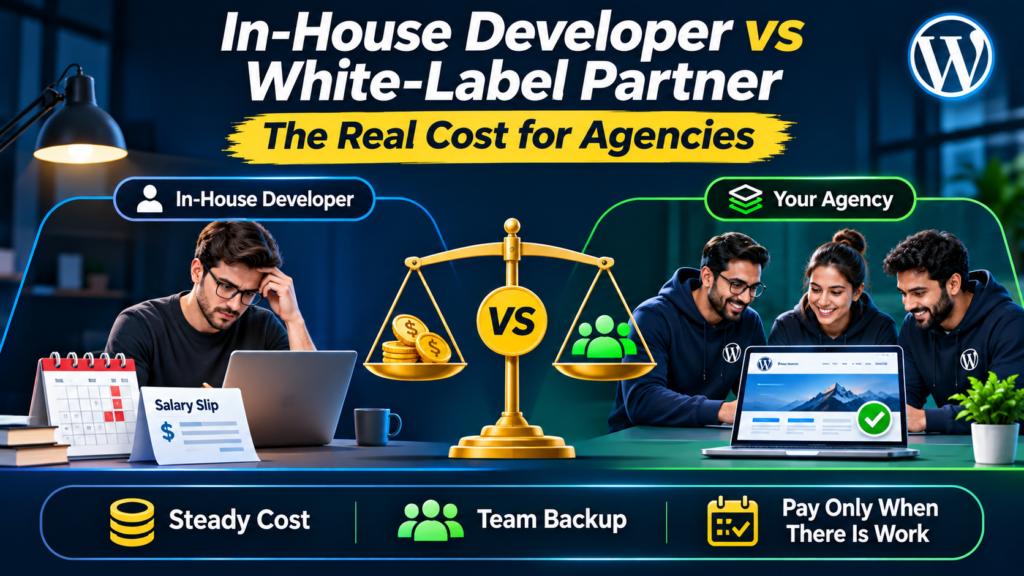
Every agency reaches the same point. Work is coming in, the team is busy, and a client is waiting for an answer. You need another developer. There are only two ways to get one: hire someone to work inside your agency, or use a white-label partner who does the work under your agency’s name. Both options can work, and both can cost you money in ways you do not expect. This post compares them properly: the cost of hiring in-house, the cost to outsource WordPress development through a white-label partner, and the questions that should decide it for your agency.
What an In-House Developer Really Costs
A salary is only the first line on the bill.
- The salary itself. This is the number everyone talks about. It is fixed every month, whether you have three projects or none.
- Hiring takes time and money. Writing the job post, reading applications, interviews, test tasks, and waiting for the right person. A good developer is not hired in a week. While that seat is empty, your team is already overloaded, or you are turning work away.
- Tools, laptop and software. A developer needs a working laptop, paid tools, licences, and a proper setup. These are small costs on their own, but they are real, and they repeat every year.
- Training and learning time. WordPress changes. Gutenberg, WooCommerce, security, and speed — a developer who does not keep learning falls behind in a year. That learning happens in work hours, and someone pays for it.
- Idle time. This is the cost agencies forget. Work does not come in a straight line. Some months you have four projects, some months you have one. The salary stays the same in a slow month. If your developer has no project for two weeks, you are still paying for those two weeks.
- Management time. Someone has to give the developer work, check it, answer questions, and fix problems when the developer is stuck. If that someone is you, that is your time — the same time you could use to find new clients.
- Leave, sickness and leaving. People take holidays. People get sick. And sometimes a good developer leaves after six months, and you start hiring all over again. A team of one has no backup. When that one person is away, the work stops.
None of this means hiring is a bad idea. It means the salary is not the total. Add the hiring, the tools, the training, the idle time and the management, and the real monthly cost is much higher than the number on the job post.
What It Costs to Outsource WordPress Development
A white-label partner works differently. You pay per project, or per month for support — and only for the work you actually have. On our side, project-based work starts from $2,000+, and monthly support starts from $1,500/mo. That is the price the agency sees. Here is what sits behind it.
- You pay only when there is work. A slow month does not cost you a salary. A busy month costs more, because you are earning more. The cost moves with your income, not against it.
- No hiring, no training, no tools. The partner already has the developer, the tools, and the process. You do not buy a laptop, you do not pay for licences, and you do not spend weeks hiring.
- A team, not one person. A partner has more than one developer. If one person is sick or on leave, someone else can pick up the work. Your project does not stop because one person is away.
- Experience you do not have to build. We have been doing this for 14+ years and 250+ projects. That experience is already in the price — the QA checks, the handover process, the mistakes we have already made and learned from. Hiring a junior developer and training them for a year costs far more than that, in time if not in money.
But a partner is not free of costs either. Here are the honest ones:
- You must manage the relationship. A partner is not your employee. You have to write a clear brief, answer questions, and check the work before it goes to the client. A bad brief will cost you revisions, just like a bad brief to your own developer would.
- You give up some control. You do not choose the partner’s working hours, and you do not see every step of the build. That is why a clear process matters — a staging site, a QA checklist, and a handover you can check. Our full workflow is explained in our guide to white-label WordPress development for agencies.
- The price can look high on a single project. If you compare one project only, a partner’s fee can look higher than one month of a junior salary. The comparison only makes sense over a full year — including the slow months, the hiring, and the management time.
A Simple Way to Compare: Do the Maths for One Year
Do not compare one month. Compare one year, because agencies live in years, not months. Use this simple table. Put your own numbers in the left column. The right column is how a partner works.
| Cost | In-house developer (one year) | White-label partner (one year) |
|---|---|---|
| Pay | Monthly salary × 12, even in slow months | Per-project fee, only when you have work |
| Hiring | Time and cost to hire, and again if they leave | None — the partner is already hired |
| Tools and setup | Laptop, licences, software | Included in the partner’s price |
| Training | Paid learning time, every year | Included — the partner keeps their own skills up to date |
| Idle time | You pay for quiet weeks | You pay nothing in a quiet month |
| Backup | None — one person, one point of failure | A team behind the work |
| Management | Your time, every week | Brief + review time per project |
Then ask three questions:
How steady is your work? If you have steady work for 12 months a year, a hire starts to make sense. If your work goes up and down, a partner is usually cheaper, because you are not paying for idle time.
How fast do you need to start? A partner can usually start on a project this week. A hire takes weeks to find, and weeks more to settle in.
What happens if it goes wrong? If your in-house developer leaves, you lose the person and the knowledge. If a partner does not work out, you can change partner on the next project — your client never sees the change, because the work is under your brand.
A Worked Example — Illustrative Only
This example uses round numbers to show the method. It is not a real salary, and it is not our rate — put your agency’s own numbers in before you decide. Suppose a developer’s salary is $1,500 a month. That looks like $18,000 a year. Now add the rest: two weeks of hiring time, tools and licences, a month of slow work with no project, and a few hours of your management time every week. Even at a low estimate, those extras can add several thousand dollars to the year — and they do not show up in the salary number at all. Now compare it with a partner: if you send the partner six projects in that year, and each project costs from $2,000 (our project work starts from $2,000+), you have spent money only on work that earned you money. In the slow months, you spent nothing. The point is not that one number is always smaller. The point is that the salary number hides half the cost, and the partner’s price shows all of it. Do your own maths, with your own months, and the answer is usually clear.
When Hiring In-House Is the Right Choice
Hiring is the right choice when:
- You have steady work for at least 12 months, with no big gaps.
- You want someone in the office or on your calls every day.
- You have work that needs the same person, on the same client, for a long time.
- You have time to hire well, train, and manage — and you enjoy doing it.
If that is your agency, hire well. Pay a fair salary, give the person good tools, and keep them. A good in-house developer is worth a lot.
When a White-Label Partner Is the Right Choice
A partner is the right choice when:
- Your work goes up and down — busy months, then quiet months.
- You need to start a project this week, not in six weeks.
- You want to offer WordPress work without hiring a full team.
- You want backup — if one person is away, the work still moves.
- You want to keep your time for clients and sales, not for managing a developer.
That is the agency we built our service for: an agency that wants to take more WordPress projects, without hiring a full-time developer for work that is not there every month. If that sounds like you, see what we do on our Services page, and our Pricing page for the full details.
FAQs
Is a white-label partner cheaper than hiring?
It depends on how steady your work is. With steady work all year, a hire can be cheaper per project. With work that goes up and down, a partner is usually cheaper, because you do not pay for idle months, hiring, or training.
What is white-label WordPress development?
It is when a partner builds a WordPress site under your agency’s brand. Your client sees your name, your emails, and your brand — never the partner’s. The partner does the build, QA, and handover to you, and you hand it to the client.
How do I know a white-label partner is good?
Ask for their process, not just their price. A good partner has a clear build process, a staging site, a QA checklist, and a handover document. Ask how they handle a project when a developer is sick, and ask to see a site they built. Our process is explained step by step in our white-label guide.
Can I hire in-house and use a partner at the same time?
Yes — many agencies do this. The in-house developer handles the regular work, and the partner takes the extra projects in busy months, or the projects that need a skill the team does not have. That way, you never turn work away, and you never pay for idle time.
What does a white-label project cost?
On our side, project-based work starts from $2,000+, and monthly support starts from $1,500/mo. The final price depends on the scope of the project — the number of pages, the design, and the features. Send your project on Discuss a Partnership and we will give you a clear price before we start.
Conclusion
The real question, when you outsource WordPress development, is not ‘salary or partner price?’ The real question is: what does a year look like for your agency? A salary is steady, but it is steady in the slow months too. A partner costs money only when there is work, and that work is what pays for it. If your work is steady and you want a person in your team every day, hire well. If your work goes up and down, or you need to start this week, a partner is usually the cheaper and safer choice. Either way, do the maths for a full year, not for one month. Count the hiring, the tools, the idle time, and your own management hours. The cheapest option is rarely the one with the smallest number on the first page. If you want to talk about which one fits your agency, send your project on Discuss a Partnership — in the first call, we will talk clearly about scope, timeline, and pricing. And tell us in the comments: did you hire in-house, work with a partner, or do both — and what would you do differently next time? For Gutenberg and custom block context, see the WordPress developer handbook.
Ideas For Your Next Build
Explore guides, technical tips and fresh perspectives for your WordPress projects.

Performance & Technical SEO
Nov, 2026
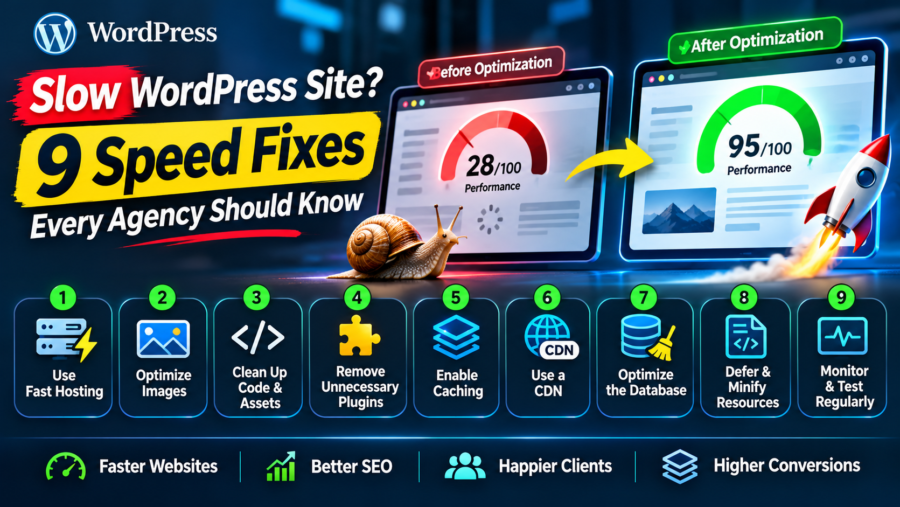
Slow WordPress Site? 9 Speed Fixes Every Agency Should Know
LET'S GROW TOGETHER
Ready to deliver more without building a bigger in-house team?
Whether you need support for one project or an ongoing delivery partner, let’s discuss how our team can work quietly behind your agency.